On 17 September 2026, Great British Energy (GBE) launched its new £20 million GBE Community Fund (the Fund) to support community-owned clean energy projects in England, Wales and Northern Ireland.
The Fund is the largest part of a wider £30 million package of “People’s Power” funding, which GBE describes as the first instalment of up to £1 billion of support for local and community-led clean energy.
The current application window closes at 11:55pm on Thursday 12 November 2026.
Late or incomplete applications will not be accepted, and with the window running for only eight weeks, community groups thinking about applying should be getting their applications together now.
Why this matters for Northern Ireland
Northern Irish organisations have not always found themselves at the front of the queue when it comes to UK-wide energy support (readers of our previous notes on the ETII support scheme may remember the NI-specific delays). It is therefore welcome that the Fund is open to NI applicants on the same footing as those in England and Wales.
Better still, the allocation process for Stages 1 and 2 will ensure that Northern Ireland receives a minimum level of funding, alongside Wales and each of the five English Local Net Zero Hub regions. Stage 3 funding, by contrast, will be allocated purely on score.
What funding is available?
Funding is available across three stages of project development. Applicants apply for the stage their project is ready for, and do not need to have received funding at an earlier stage to do so:
- Stage 1 – Feasibility (up to £40,000): to test whether a project idea is viable. This can cover technical and feasibility studies, land and consenting scoping, community engagement and the design of the governance and ownership model. Applicants will need to establish a clear project idea or technology and a prospective site (or a credible shortlist of sites).
- Stage 2 – Development (up to £100,000): to turn a viable idea into an investment-ready project, up to final investment decision. This can cover detailed design, planning, grid connection, land and option agreements (but not land acquisition), and legal, governance and financial development work. A completed feasibility study and evidence of community engagement are required.
- Stage 3 – Capital (up to £3 million): capped at 50% of total project capital costs, to help construction-ready projects bridge a remaining funding gap. Applicants will need planning permission, a secured grid connection, signed land agreements, a construction plan and evidence of third-party funding. Only capital costs (equipment, construction, installation and associated infrastructure) are eligible – legal fees, staff costs and development costs are not.
Each stage is assessed independently, so funding at one stage does not guarantee funding at the next. Notably, GBE can offer an applicant a lower grant amount that it had originally applied for so the figures above are not guaranteed for eligible projects.
Who can apply?
To be eligible, an applicant must:
- be a legally constituted and incorporated community organisation based in England, Wales or Northern Ireland (for example, a community benefit society, co-operative society, community interest company, charitable incorporated organisation, development trust, registered charity or registered social landlord);
- be set up to run energy projects for local benefit;
- have a bank account with at least two signatories; and
- put forward a project designed to be at least 50% community owned when operational.
Local authorities (other than town, parish and community councils) and schools cannot apply directly, although a community group can apply for a project on a school site with the support of the school and the landowner. Joint applications are possible, with a lead partner holding the grant agreement.
Community ownership – read the small print
The community ownership requirement has real teeth. The community organisation must hold at least a 50% legal and financial interest in the project, meaning at least 50% of the issued share capital and voting rights, and an entitlement to at least 50% of the financial returns.
Applicants must also show that a defined share of the benefits will be retained for, or delivered to, the local community: what those benefits are, who receives them, how they are calculated, when they arise and how they will continue. The guidance is clear that vague claims of “community benefit” will not be enough.
Where a project involves a commercial developer or another co-investor, the ownership structure, shareholders’ agreement and any profit-sharing arrangements will need to be thought through carefully at the outset (as lawyers, we would say that, but in this case the scoring depends on it).
Eligible technologies
The eligible technologies differ between stages:
- Stages 1 and 2: wind, ground and rooftop solar, hydropower, anaerobic digestion (electricity), biogas and biomass heat networks and solar thermal. Heat pumps and battery storage are eligible only when combined with one of these technologies. Stage 1 can also support certain community energy advice and bulk-buy retrofit projects.
- Stage 3: wind, ground and rooftop solar, hydropower and anaerobic digestion (electricity), with battery storage eligible only alongside one of these. Stage 3 projects must be connected at distribution level.
Points to note for Northern Irish applicants
Beyond the core criteria, there are several points NI applicants in particular should bear in mind:
- Subsidy control and the Windsor Framework: awards are generally made under the Subsidy Control Act 2022. However, applications with a relevant connection to Northern Ireland will be screened and, where Article 10 of the Windsor Framework applies, an award can only be made where GBE has verified an EU State aid legal basis (such as de minimis aid or the General Block Exemption Regulation). Stage 1 and 2 grants that engage the Windsor Framework will be made on a de minimis basis, so applicants will need sufficient de minimis headroom, taking account of any other public funding they have received.
- Grid connections: Stage 3 requires a secured grid connection. Given current network constraints in parts of Northern Ireland, groups planning a capital application in a future window should be engaging with NIE Networks well in advance.
- Spend deadline: grant funding must be spent and claimed by 31 March 2028. For Stage 3 projects in particular, the build programme needs to be realistic.
- Pre-application support: Advice NI is providing additional pre-application support to Northern Ireland applicants and is worth contacting early. All applications, however, are submitted directly to GBE.
How will applications be assessed?
Applications are scored from 1 to 5 against five criteria: organisational capacity and governance, project viability and deliverability, community ownership and benefit, finance (including value for money) and risk management. Applicants need a score of at least 3 in every area, so a strong project can still fall at the first hurdle if, for example, its governance or risk management is underdeveloped.
For Stages 1 and 2, viability, community ownership and finance each carry 25% of the weighting. For Stage 3, the emphasis shifts towards viability (30%), finance (20%) and risk (20%).
Key dates
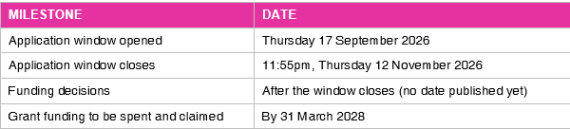
Conclusion
The Fund is a welcome and practical source of support for community energy in Northern Ireland, particularly at the feasibility and development stages, where early funding can often make or break a project.
With the window closing on 12 November 2026, the most realistic applications this round are likely to be Stage 1 and Stage 2 bids from groups that already have a clear technology, site and governance structure in mind. GBE may open further windows if funds remain, but there is no guarantee of that. GBE can also choose to shorten the application window, so we would encourage anyone considering a project to review the Fund guidance and eligibility criteria now, speak to Advice NI and check their ownership structure and de minimis position before submitting.
For legal guidance and advice regarding a community energy project, including ownership and governance structures, land arrangements, grid connection agreements, battery storage, power purchase arrangements or subsidy control, please contact Andrew Kirke, Charlotte Gourley or a member of the Energy team.
While great care has been taken in the preparation of the content of this article, it does not purport to be a comprehensive statement of the relevant law and full professional advice should be taken before any action is taken in reliance on any item covered.
